When I first started learning, I was somewhat confused by problems like "rotate a certain curve around the axis." This article will provide a detailed explanation with illustrations to clarify this issue for readers.
Such problems may require finding the surface equations formed by rotating parabolas or hyperbolas around a certain axis.
When a curve rotates around the x-axis, the and coordinates of each point will form the equation of a circle, with a radius equal to the absolute value of the original coordinate. In other words:
How do we determine ? Since the curve lies in the plane, the value of any point on the curve at the start of the rotation is the radius. Thus, we have:
Therefore, we only need to replace in the curve with to derive the new surface equation.
Similarly, when rotating around the y-axis, the value of is the radius, so we have:
Note that it is important to identify which plane the curve is located in before determining the radius. For curves in the plane, the replacement equation is slightly different. This will not be demonstrated here:
- Rotating around the axis:
- Rotating around the axis:
- Rotating around the axis:
This image demonstrates the rotation of a parabola in the plane around the x-axis by 180 degrees. The right side shows the front view, and it is easy to see:
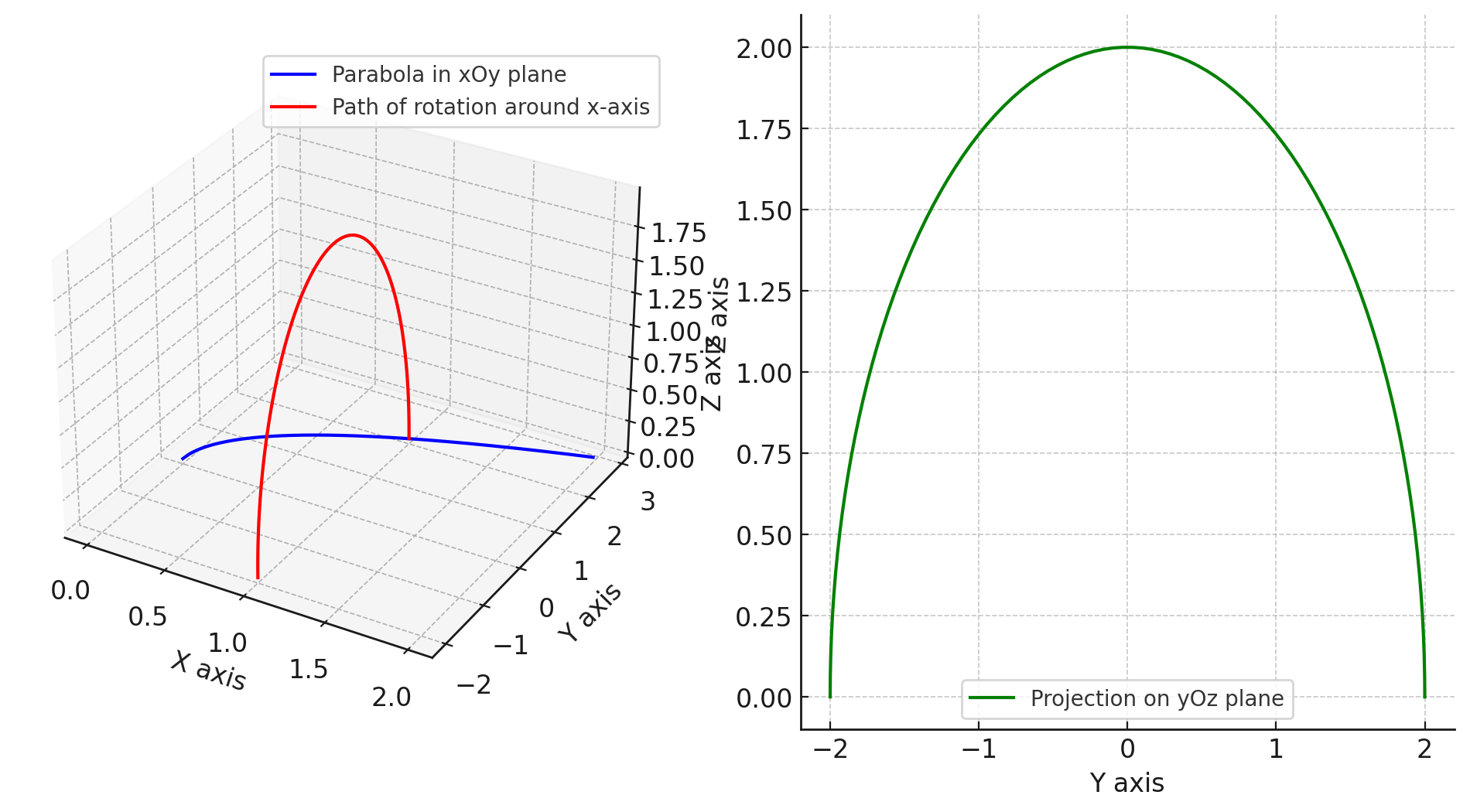
To make it easier to remember the value of , you can understand it this way: To choose one of the three values as , simply remove the coordinate axis around which you are rotating, and then select the intersection of the remaining two values with the two values of the plane.
For example, if a curve in the plane rotates around the axis, you remove the x-axis, leaving y and z. Then, find the intersection of y and z with x and y to determine that is .