On the eve of Teacher's Day, I think of two teachers from my past.
One of them was my English teacher in the first year of middle school—equivalent to sixth grade where I studied. The image that remains in my memory is of her in a yellow sheer long dress, with jet-black hair, and a sense of being in her forties.
Her surname was Song. English teachers usually have their own English names, but I probably don’t remember hers—maybe it was “Julie,” “Jane,” or “Jessica.” I heard from someone that she had a husband from New Zealand. At that time, my classmates might have thought New Zealand was just a name for a vitamin. I knew where New Zealand was, but who knew the value of going there back then?
She would arrive in the classroom three minutes early, writing a few letters in the lower right corner of the blackboard to indicate the day's lesson. Of course, this wasn’t something that excited everyone; it usually meant dictation, recitation, or checking homework. I don’t remember the specific codes, but each item was made up of two letters. It seemed that every student was treated as an adult by her; she assumed everyone saw what she wrote, so she never mentioned those letters again.
I was afraid of being criticized, so I often completed my homework several days in advance.
Once, when I submitted my homework, she noticed I had already finished the later sections. She shifted her gaze from my notebook to the student below me and told the whole class that I had “Jewish wisdom.”
That was the first time I realized that a Chinese person could lack what is called Chinese wisdom.
On the first day of school, she gave everyone an English name. She said mine was Bob, and she would always call us by our English names, whether it was for criticism, roll call, or praise. Even after she stopped teaching us, I still remembered several classmates' English names.
In Chinese English exams, there is a type of question called “cloze test,” which runs through a child's education from elementary school to university. The content involves an article with several missing words, providing options for each blank for you to choose from. She taught us a habit: to directly fill in the options and content into the article.
I maintained this habit all the way to university. By high school, English was no longer a burden for me; I finished every exam half an hour early. I had never seen anyone else with this habit, even though I told everyone who asked me for exam tips about it.
I often tell others that she was my “English enlightenment teacher.” It’s not because my English improved dramatically after that year, but because she brought me a different way of thinking, one that was unlike traditional Chinese views.
Besides her, there was another teacher who didn’t see me as a traditional Chinese person. That was my homeroom teacher in the fourth grade, who was also my Chinese teacher.
Now this “she” refers to a different person. Interestingly, her surname was also Song.
I have always liked to doodle in my books. I clearly remember a particular theme in my practice book called “Physical Water Flow Calculation” (let me call it that for now), which looked something like this:
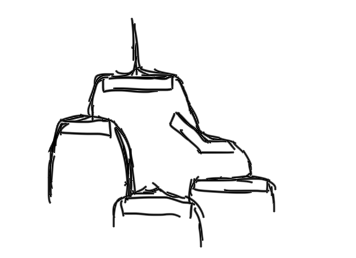
There was nothing special about it; it was just simulating the physical flow of water. When I encountered printed text in the practice book, I would even mimic the influence of the text on the water flow. However, many teachers, including my parents, criticized me for doodling in my books (even though I drew much better by middle school, I still received a lot of criticism). She didn’t criticize me; instead, she told the whole class that “his (my) drawings are very interesting.”
I have always been a bit of an outsider, and such inclusive acceptance is something I can count on one hand.
After school, everyone had to line up, and she liked to stand next to me, chatting as we walked.
She only taught me for a year. One day, she called me to her office and took out a book called “The Boy Who Collected Glass” from a drawer at her feet and gave it to me. She didn’t say much, or maybe I just don’t remember. I repeatedly tried to understand this book, which revolves around a group of people living in Cairo who survive by collecting waste. I can no longer find this book because I moved; the cover featured a boy's profile, walking down the street with garbage on his back.
As I write this, I begin to reflect on why she gave me this book and why it was this particular book, rather than a comic or detective novel that every boy that age would love.
The protagonist in the book, living at the bottom of society, faces rejection and misunderstanding from both his own kind and others. Perhaps she saw the difficulties I would encounter as I grew up and hoped to give me strength through this book.
I was 10 years old, and the boy collecting glass was 15. If she saw me again, would I be the person she envisioned I would grow up to be?
Later, like all Chinese children, I went through middle school, high school, and university. Chinese and English happened to become my two strongest subjects. Perhaps this is fate amidst the impermanence of life.
The teachers that followed have faded into mere faces in my memory, with nothing worth writing about. Now I can understand; after all, everyone is weighed down by life, who would care if they are remembered by an insignificant student?
I can’t say whether they truly changed me, but what they gave me has certainly become a part of me in some form.
On this Teacher's Day, I want to say thank you to them, even though I can never repay that sincere affection in my lifetime.
I truly hope they can see this article.