Introduction
This article is aimed at Chinese native speakers who wish to learn Cantonese.
Since I started learning Cantonese last summer, I can now understand Cantonese movies and news without subtitles. This article will share my learning experiences and insights. Of course, as with learning any language, reading just one article is not enough; continuous listening and speaking practice is essential. This article can only point learners in the right direction.
Why Learn Cantonese?
In fact, the purpose of learning is to enjoy the process.
- Cantonese has about 120 million speakers in China and a large audience overseas. It is the only Chinese language, apart from Mandarin, that has independent research in foreign universities.
- Mastering Cantonese allows for a subtle joy in communicating with locals in Cantonese-speaking regions (I believe anyone who has mastered a foreign language can relate to this feeling).
- Hong Kong films and songs hold significant positions in world culture, and mastering Cantonese undoubtedly allows you to enjoy them from a VIP seat.
- Many Tang and Song dynasty poems were actually written in Cantonese. For example, Liu Zongyuan's famous "Jiang Xue" (River Snow) sounds even more flavorful when recited in Cantonese.
The Relationship Between Cantonese and Chinese
Cantonese is a dialect of Chinese, meaning that it is part of the vast Chinese language system. Cantonese is widely spoken in Guangdong Province, Hong Kong, and Macau, as well as in some areas outside Guangdong (such as certain Chinese communities in Malaysia and Vietnam).
Although Cantonese is a dialect of Chinese, it has significant differences in phonetics, grammar, and vocabulary compared to Mandarin (also known as Standard Chinese or Northern dialect). For example, Cantonese has more tones than Mandarin. In terms of vocabulary, Cantonese also has some unique words and expressions, especially in everyday conversation. Cantonese retains many ancient words and grammatical structures (similar to Japanese).
Phonetic System
For native Chinese speakers, it is possible to start learning directly from the phonetic system. Over the past year, I have mainly done the following two things:
- Completed the Cantonese course on Duolingo: After finishing this course, you will have a basic understanding of the overall phonetic and grammatical system of Cantonese and be able to handle everyday communication situations, such as dining and job hunting.
- Regularly watched Hong Kong TVB news: In addition to keeping up with the latest developments in Hong Kong, you will gain the closest experience to contemporary spoken Cantonese. You can watch it for free on YouTube.
To achieve authentic pronunciation, you can use my online Cantonese romanization converter to learn the sounds.
After completing these two tasks and with the passage of time, you will be able to communicate with native Cantonese speakers.
The next task is: to understand Cantonese songs.
Writing System
Modern Cantonese can share a writing system with Mandarin. For example, a passage from the Hong Kong SAR government website reads:
All Hong Kong residents aged 11 or above (except those who are exempt or do not need to register) must register and obtain an identity card. This webpage will provide information about Hong Kong identity cards, including how to apply for or replace an identity card, how to apply for a certificate showing the details registered on the identity card, how to apply for an exemption from registering for an identity card, how to make an appointment to apply for an identity card, and where to find more related information.
As long as you recognize enough traditional characters, you will have a basic grasp of the writing system. Additionally, as an optional part, many native Cantonese speakers use simplified characters when typing, often mixing in some simplified characters to represent modal particles.
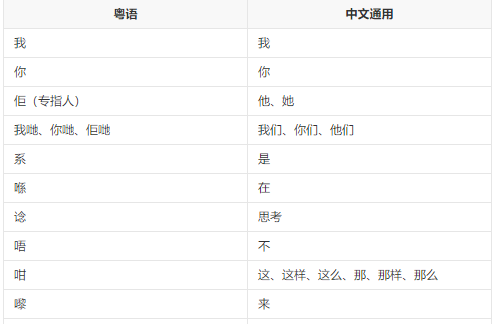
Advanced: Lazy Sounds
The "lazy sounds" in Cantonese refer to the phenomenon of omitting or simplifying pronunciations in certain situations, particularly common in Hong Kong Cantonese. Not all Cantonese speakers use lazy sounds, and the degree of usage varies by region and context.
In Cantonese, some syllable endings may be omitted. For example, the endings "-ng" and "-k" may be dropped in some cases. Thus, words like "香港" (Heung Gong) may be pronounced as "Heung Gon" or "Heun Go" in lazy sound situations.
Similarly, certain initials, such as "n-" and "l-", may be confused or interchanged in some cases. For example, "你" (nei) may be pronounced as "lei."
Although lazy sounds are common in certain Cantonese communities, standard pronunciations are usually maintained in formal written language or news reports.
Advanced: Slang
- “食死猫”: Refers to taking the blame for something.
- “踢晒脚”: Describes being extremely busy.
- “冇雷公咁远”: Means very far away.
- “静鸡鸡”: Describes being very quiet.
- “牙烟”: Means dangerous.
- “黐线”: Describes someone as being mentally unstable.
- “湿湿碎”: Means something is trivial or easy.
- “一旧水”: Refers to one hundred dollars.
- “论尽”: Describes clumsy or slow actions.
- “鸡啄唔断”: Describes someone who talks non-stop.